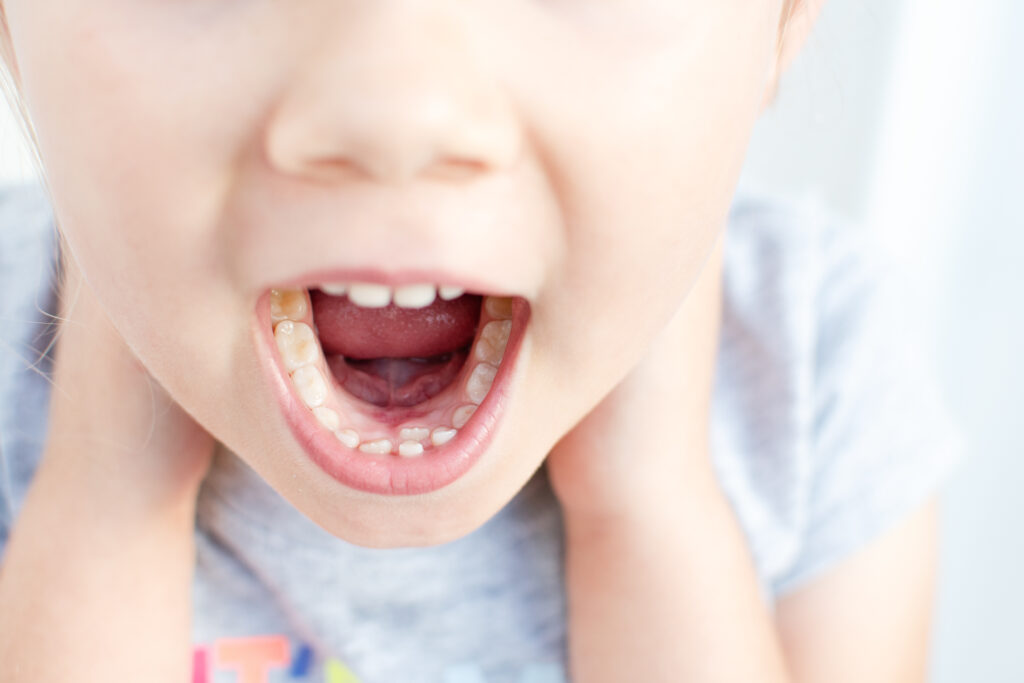
You peer into your child’s mouth during their nightly brush routine and stop cold: there is a brand-new tooth growing directly behind one that has not fallen out yet, and it almost looks like a second row. Before panic sets in, know that what you are seeing is one of the most common things that happens during childhood dental development, and it almost always has a straightforward path forward.
At Kids Dental Center, we know that moments like this can catch parents completely off guard. Our team is dedicated to making every visit warm, welcoming, and stress-free because every child deserves the absolute best dental care at every stage of their growing smile.
What Are Shark Teeth?
The nickname “shark teeth” describes what happens when a child’s permanent tooth begins to come in behind a baby tooth that has not yet fallen out, creating the appearance of a double row. The clinical name for this is ectopic eruption, and it simply means the new tooth is emerging in a slightly different position than expected.
Normally, the permanent tooth pushes upward and gradually dissolves the root of the baby tooth in front of it, nudging it loose until it falls out on its own. With shark teeth, the baby tooth’s root does not dissolve quickly enough, so the permanent tooth does not have a clear path forward and erupts behind it instead. This most commonly appears in the lower front teeth in children between the ages of five and seven, though it can show up in the upper front teeth or near the back molars as well.
What Causes Shark Teeth?
Ectopic eruption can happen for several reasons. In many cases, it comes down to timing: the permanent tooth begins its journey upward before the baby tooth’s root has had enough time to fully resorb. Other contributing factors can include limited space in the jaw, differences in size between the baby and permanent teeth, prior dental trauma, or simply natural genetic variation in how your child’s teeth develop.
The important thing to understand is that this is rarely a sign that something is seriously wrong. It is a common, well-recognized part of childhood dental development that many families go through, and most cases resolve without any major intervention.
Does It Need Treatment?
Knowing when to wait and when to act is the key to navigating shark teeth with confidence. The answer depends on how the baby tooth is responding and how far the permanent tooth has already come in.
When It Resolves on Its Own
If the baby tooth in front is already a little wiggly, the best first step is encouraging your child to wiggle it with clean hands or their tongue throughout the day. As the permanent tooth continues to push upward, it will often dissolve more of the baby tooth’s root, making it progressively looser until it falls out naturally. Once the baby tooth is gone, the tongue applies gentle forward pressure on the permanent tooth over the following weeks or months, gradually guiding it into the correct position. Most of the time, no further steps are needed once the baby tooth is out.
When a Dentist Should Evaluate It
If the baby tooth shows no movement after four to six weeks of wiggling, if the permanent tooth has nearly reached the height of the baby tooth with no loosening in the baby tooth, or if your child is experiencing pain or swelling, it is time to schedule a visit. In many of these situations, a simple extraction of the baby tooth is all it takes to get things moving in the right direction. When shark teeth appear in the upper front teeth, extraction is more commonly recommended because the tongue is less effective at nudging upper teeth into place without assistance.
Monitoring for Future Alignment
Some cases of ectopic eruption are connected to spacing or crowding patterns in the jaw. A pediatric orthodontic evaluation can give you a clearer picture of how your child’s permanent teeth are tracking overall and whether any early guidance would be helpful. In certain situations where shark teeth occur across multiple teeth or in less common areas, a space maintainer may also be discussed as a way to preserve proper spacing while the permanent teeth continue coming in.
Caring for Your Child’s Teeth During This Phase
While shark teeth are present, keeping up with thorough brushing habits is especially important. A double row of teeth can trap food and plaque more easily than usual, so helping your child brush carefully around both the baby tooth and the incoming permanent tooth supports their overall gum health during the transition.
Staying current with cleanings and exams also allows us to monitor the eruption pattern over time and step in at exactly the right moment if assistance is needed. Staying attentive during this phase makes a real difference in how smoothly things resolve.
Kids Dental Center Is Here for Every Stage of Your Child’s Smile
At Kids Dental Center, we believe every child deserves exceptional dental care, regardless of their background or insurance situation. Dr. Wright and our team bring warmth, expertise, and a genuine love for working with kids to every single appointment, and we are proud to offer an environment where children feel safe and parents feel supported.
If you have noticed shark teeth in your child’s mouth and want a professional set of eyes on it, we are ready to help. Contact our office to schedule an appointment today.